

For mortgage lenders and finance teams, document processing is no longer about getting text off a page. It is about converting financial documents into validated, decision-ready data. Yet, many lending organizations remain caught in a cycle of upgrading legacy Optical Character Recognition (OCR) systems, hoping incremental enhancements will resolve persistent document-processing bottlenecks.
In most cases, incremental upgrades alone are not enough to address the underlying limitations of legacy document-processing approaches.
If you are evaluating software for financial workflows, it is important to cut through the marketing buzzwords. Let us look at how document technology has evolved from basic OCR to modern Intelligent Document Processing (IDP), why traditional systems struggle under real-world conditions, and how a smarter approach is helping financial institutions transform document-intensive operations
1. The Three Generations of Document Tech
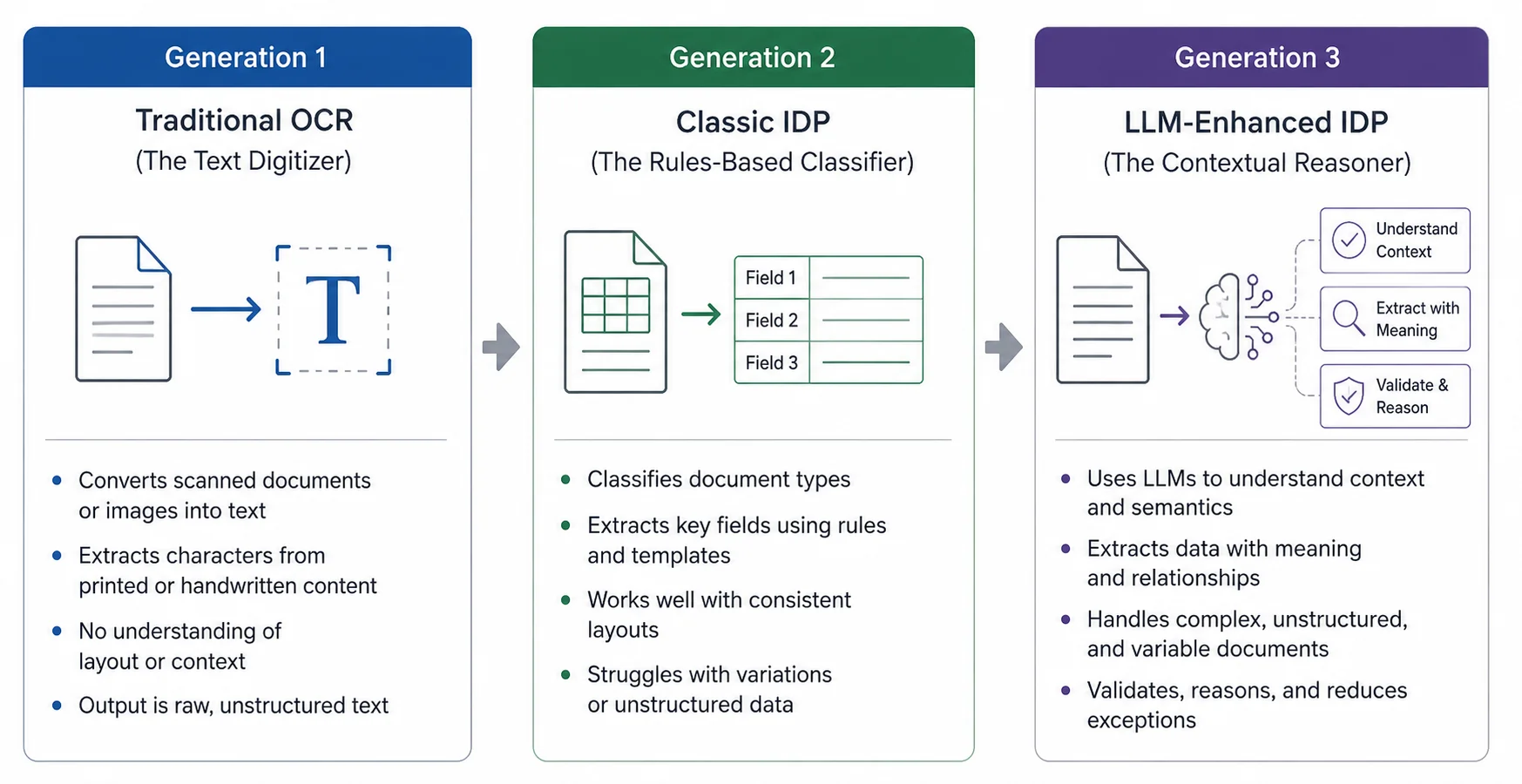
To choose the right solution for your team, it helps to understand how document software has evolved. The industry has gone through three major shifts.
Generation 1: Traditional OCR (The Text Digitizer)
Traditional OCR is a basic tool that translates an image of text into digital characters. It takes a scanned PDF or a photo of a document and isolates the letters and numbers so you can copy and paste them.
- The Business Limit: Traditional OCR has no understanding of what it is reading. It cannot tell the difference between a routing number and a phone number because it only sees a string of digits.
Generation 2: Classic IDP (The Rules-Based Classifier)
Intelligent Document Processing introduced machine learning and rule-based automation to classify documents, extract named fields, and route structured data into downstream workflows. Instead of just dumping text, an IDP system identifies the type of document, such as a W-2 or a pay stub, and looks for specific fields to extract data into a structured format.
- The Business Limit: It relies heavily on predictable structures. When a document layout changes, classic IDP systems often struggle when document layouts vary significantly from the formats on which they were trained.
Generation 3: LLM-Enhanced IDP (The Contextual Reasoner)
The latest generation integrates Large Language Models (LLMs) to interpret context, relationships, and meaning across complex financial documents. Instead of relying solely on fixed locations or predefined templates, these systems can analyze documents in a way that more closely resembles how an underwriter evaluates relationships between fields, sections, and supporting records. When combined with document intelligence and validation frameworks, LLMs can identify connections across documents, analyze contextual information, and surface insights that traditional extraction approaches may miss.
2. Why Templates Fail in Lending
If your operations rely on software that uses rigid templates, the ROI from automation is likely to decline as document variability increases. In complex lending ecosystems, a low-priced OCR tool will fail because it cannot handle real-world document variations.
Traditional systems map document data using fixed locations on a page. For example, the software expects the applicant’s name to always be exactly two inches from the top margin. This rigid logic fails in everyday mortgage processing for several reasons:
- Layout Shifting: Financial documents come from thousands of different employers, banks, and title companies. A pay stub from one company looks completely different from another. Even a minor alignment shift during scanning can cause an OCR tool to read the wrong line item.
- The Stray Mark Problem: A coffee stain, a blurry fax line, scanner dust, or an applicant’s handwritten signature over a line of text will alter the visual layout. A template-matching system will often misread the text or flag it as an error, sending the file to your team for slow, manual review.
- Unstructured Scale: Closing packages, bank statements, and supporting financial documents often vary by source, layout, quality, and submission format. Trying to build and maintain thousands of distinct templates for every possible version of a bank or tax form creates a massive operational burden for your team.
3. The Hybrid Advantage (OCR + LLM + Validation)
Using a standalone LLM for document processing is not a complete solution either. While LLMs are highly intelligent, they can sometimes miscalculate numbers or generate inaccurate outputs when working solely from unstructured text. For high-stakes financial workflows, contextual understanding must be paired with structured extraction and rigorous validation.
The most effective approach is a hybrid architecture that combines OCR, LLMs, and validation frameworks to transform documents into trusted, decision-ready data.
The OCR Layer
The OCR engine acts as the eyes of the system, capturing text and numerical values from documents with high fidelity. This layer extracts information from scanned PDFs, images, and financial records, creating a structured foundation for further analysis.
The LLM Layer
The LLM acts as the reasoning layer. Instead of searching for strict labels or predefined positions, it evaluates surrounding text, document context, and relationships between fields to interpret the meaning of the information being processed.
The Validation Layer
The validation layer acts as the control mechanism. Extracted data is checked against configurable business rules, cross-document relationships, and workflow requirements before it enters downstream systems. This helps identify inconsistencies, missing information, and potential extraction errors, ensuring that contextual understanding is paired with operational trust.
Contextual Extraction in Action
For example, a traditional system may confuse a deposit line, gross receipts figure, or rental income amount because it only sees labels and positions. A hybrid system evaluates surrounding line items, document type, borrower context, and applicable rules to determine whether the figure represents net rental income, even if that exact phrase never appears on the document. The validation layer then confirms the extracted value against supporting documents and business logic before it moves into the workflow.
By combining OCR for reliable text capture, LLMs for contextual interpretation, and validation frameworks for trusted execution, financial institutions can improve extraction accuracy while ensuring the consistency and reliability required for complex lending workflows.
4. Choosing the Right Engine with DocVu.AI
When processing high-stakes financial data, you cannot rely on tools that guess. You need a platform built for complex, document-heavy mortgage and finance workflows.
For high-stakes financial services workflows, this hybrid approach is becoming the new standard: OCR for reliable text capture, LLMs for contextual interpretation, and validation logic for trusted workflow execution.
DocVu.AI delivers a sophisticated hybrid platform designed to replace brittle templates with resilient, context-aware automation. By combining advanced OCR precision with specialized financial language models, DocVu.AI ensures your data is not just captured, but validated against configurable business rules, enriched with context, and prepared for workflow execution.
If your team is ready to scale operations, DocVu.AI offers tailored solutions built for your specific business needs:
- Streamline Risk Assessment: Speed up loan processing by converting document-heavy files into structured, validated data for review.
- Automate Compliance Checks: Cross-check credit reports, bank statements, tax returns, and supporting documents against configurable rules.
- Accelerate Underwriting Workflows: Support debt-to-income analysis, asset verification, income review, and exception handling with context-aware data extraction.
Move beyond template-driven automation and adopt a document intelligence platform built for the complexity of modern financial operations
See how DocVu.AI turns complex mortgage and financial documents into validated, decision-ready data for faster workflow execution.