

Every mortgage application follows a familiar journey.
A borrower submits an application. Documents are collected. Income, assets, and employment details are verified. Underwriters review the loan package, conditions are cleared, and the file moves toward approval.
Behind every stage, there is document work. Mortgage teams review pay stubs, W-2s, tax returns, bank statements, disclosures, purchase contracts, and supporting records before a loan is ready to move forward.
This is why AI is becoming more relevant in mortgage operations. According to Fannie Mae’s mortgage lender research, 73% of lenders cited improving operational efficiency as the primary motivation for adopting AI or machine learning in 2023, compared with 42% in 2018.
Rather than replacing mortgage professionals, AI helps reduce repetitive document work. Combined with Intelligent Document Processing, it can classify documents, extract key information, organize loan files, identify exceptions, and support faster reviews throughout the mortgage lifecycle.
In this guide, we explore how AI supports the mortgage journey from application to approval, and why Intelligent Document Processing has become an essential capability for modern mortgage operations.
What is Mortgage Lifecycle Automation?
Mortgage lifecycle automation refers to the use of intelligent technologies to simplify document handling and workflow activities throughout the loan process, from application through approval.
Instead of automating lending decisions, it focuses on reducing the manual work that supports every stage of mortgage processing. This includes collecting documents, classifying files, extracting information, validating data, routing exceptions, and preparing organized loan packages for review.
When powered by Intelligent Document Processing, mortgage lifecycle automation helps create more efficient workflows while giving mortgage professionals greater visibility into the documents that drive every loan.
Understanding the Mortgage Lifecycle
Every mortgage loan follows a structured process, but the volume of documentation grows as the loan progresses. Documents collected at the beginning continue to support decisions throughout processing, underwriting, and approval.
A simplified mortgage lifecycle looks like this:
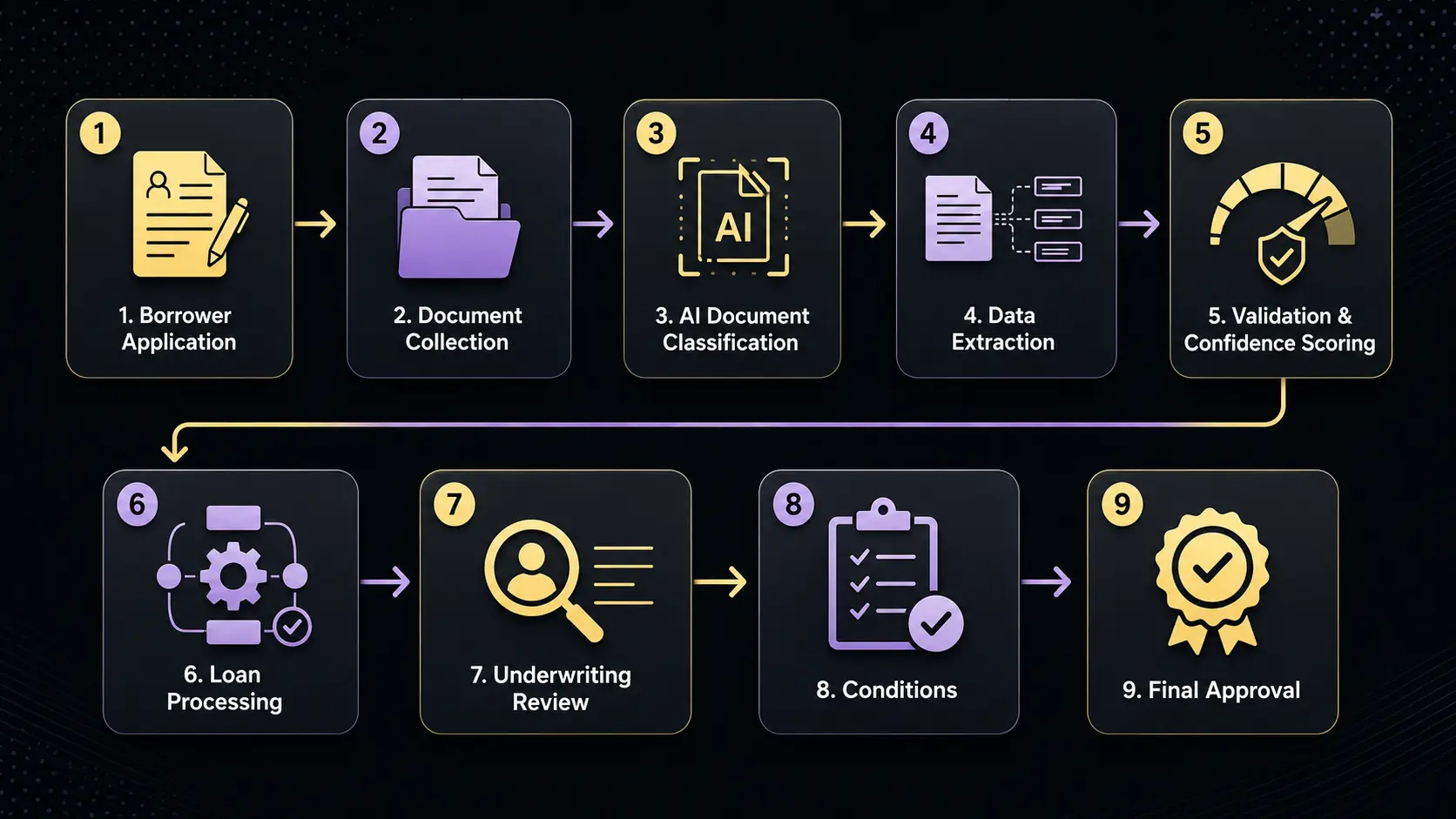
Each stage depends on complete, accurate, and well-organized documentation. When documents are missing, duplicated, or difficult to locate, delays quickly affect the rest of the workflow. Improving document handling early in the process helps every downstream team work more efficiently.
How AI Supports every Stage of the Mortgage Lifecycle
Artificial Intelligence delivers the greatest value when it simplifies repetitive document tasks without disrupting existing mortgage workflows. Instead of replacing experienced professionals, AI helps processors and underwriters spend less time preparing documents and more time reviewing loan quality.
1. Application and Document Intake
The mortgage process begins with collecting borrower information and supporting documentation. Depending on the loan, this may include W-2 forms, pay stubs, tax returns, bank statements, purchase agreements, insurance documents, identification records, and additional supporting files.
Managing these documents manually often requires processors to organize files before any meaningful review can begin.
AI helps by identifying document types as they enter the workflow, creating organized loan files from the start. This reduces manual sorting and helps establish consistency across incoming applications.
2. Intelligent Document Classification
A mortgage file contains many different document types that often appear similar at first glance.
For example:
- W-2 forms
- Pay stubs
- Tax returns
- Bank statements
- Asset statements
- Driver’s licenses
- Loan Estimates
- Closing Disclosures
- Purchase contracts
- Insurance documents
Accurately classifying each document is an important first step before processing begins.
Intelligent Document Processing uses AI to recognize document types automatically, reducing the need for manual organization and helping processors work from structured loan packages.
3. Intelligent Data Extraction
After documents have been classified, mortgage professionals still need access to the information contained within them.
Traditionally, processors manually review documents to locate borrower names, employer details, income figures, account balances, property addresses, and other key information.
Intelligent Document Processing extracts relevant information from supported mortgage documents and presents it in a structured format while maintaining a direct connection to the original source document.
It can also validate information across related mortgage documents, helping identify inconsistencies early in the process. By surfacing potential issues before they reach underwriting, mortgage teams can reduce rework and move loan files forward more efficiently.
4. Confidence Scoring and Exception Management
Not every document requires the same level of review.
Some documents are complete, clear, and easy to interpret. Others may contain poor scan quality, handwritten notes, missing pages, or inconsistent formatting.
Modern AI systems help distinguish between these situations using confidence scoring.
Higher confidence results can move forward more efficiently, while lower confidence extractions can be routed for human validation before additional processing occurs.
This allows mortgage professionals to focus their expertise where it matters most while creating a more structured exception management process.
5. Supporting Underwriting with Organized Loan Files
Underwriters make important lending decisions based on the quality and completeness of the loan package they receive.
When documentation is inconsistent or incomplete, valuable time is often spent locating missing information before the actual underwriting review begins.
AI supported document workflows improve this experience by organizing documentation before underwriting review starts. Documents remain consistently categorized, extracted information is easier to locate, and supporting records are presented in a structured manner.
This allows underwriters to spend more time evaluating borrower information and less time navigating paperwork.
Intelligent Document Processing versus Traditional OCR
Many organizations still associate document automation with Optical Character Recognition, commonly known as OCR.
While OCR remains useful for converting printed text into machine-readable text, modern mortgage operations require significantly more than text recognition.