

Commercial lending is fundamentally an information-driven enterprise. Yet, for many financial institutions, the document intake stage remains one of the largest operational bottlenecks in the lending lifecycle. Before an underwriter can effectively evaluate credit risk, assess collateral, or structure a complex commercial facility, a comprehensive portfolio of multi-source documentation must be collected, reviewed, and precisely structured.
When files arrive simultaneously from multiple stakeholders—including borrowers, property management companies, and certified public accountants (CPAs)—the intake process often slows down significantly. These upstream operational challenges directly impact operational efficiency, inflate cost-per-loan metrics, and degrade the client experience. To maintain a competitive advantage, commercial lenders must transcend legacy capture methods and implement an enterprise-grade strategy for document ingestion.
Why Does Multi-Source Submission Create a Process Logjam?
In commercial lending environments, critical data rarely arrives in a centralized, pre-formatted manner. Instead, processing and operations teams must manage a continuous, unpredictable influx of documentation originating from disparate communication channels. A standard commercial real estate transaction or corporate credit facility requires documentation from a multitude of independent stakeholders, each leveraging localized delivery methods.
- Unstructured Email Channels: Borrowers routinely submit financial updates, asset statements, and corporate tax returns via fragmented, ad-hoc email correspondence.
- Third-Party Platforms: CPAs and financial advisors frequently utilize external, secure file-sharing networks or disparate cloud storage repositories to distribute audited financial statements.
- Property Management Systems: Property managers upload localized rent rolls and operating statements generated directly from specialized, non-standardized accounting software.
This operational complexity is compounded by the structural variability of the documentation itself. Lenders must simultaneously ingest highly structured forms, semi-structured corporate financial statements, and entirely unstructured documents such as complex legal contracts or lease agreements. Consequently, operational teams dedicate significant manual hours to downloading files, executing manual nomenclature updates, and attempting to construct a coherent credit file. This resource-intensive baseline introduces severe administrative latency at the absolute inception of the lending lifecycle.
Why Do Standard Digital Portals Fail to Eliminate Document Iterations?
To mitigate these systemic inefficiencies, many financial institutions have invested heavily in consumer-facing digital intake portals. While these platforms provide a secure destination for document upload, they address only part of the problem. Most portals can receive files, but they cannot verify whether the correct documents have been submitted.
Common issues include:
- Borrowers uploading outdated financial statements or tax returns.
- Incorrect document types being submitted in place of requested records.
- Corrupted, incomplete, or blank files passing through unchecked.
Because traditional portals validate file delivery rather than file content, these submissions are often accepted without review.
As a result, operations teams must manually identify issues, contact borrowers, request replacements, and restart portions of the review process. This creates avoidable delays and increases administrative workload.
How Can Intelligent Document Classification Accelerate Intake?
Traditional OCR solutions can convert scanned documents into text, but they often lack the ability to understand document context. Modern Intelligent Document Processing (IDP) platforms go further by classifying documents, extracting relevant information, and validating data using machine learning and computer vision.
By deploying sophisticated ingestion engines directly at the entry point, institutions can analyze, identify, and categorize incoming files instantly, irrespective of the ingestion channel or original format. This architecture acts as an intelligent gatekeeper, functioning continuously to optimize document readiness.
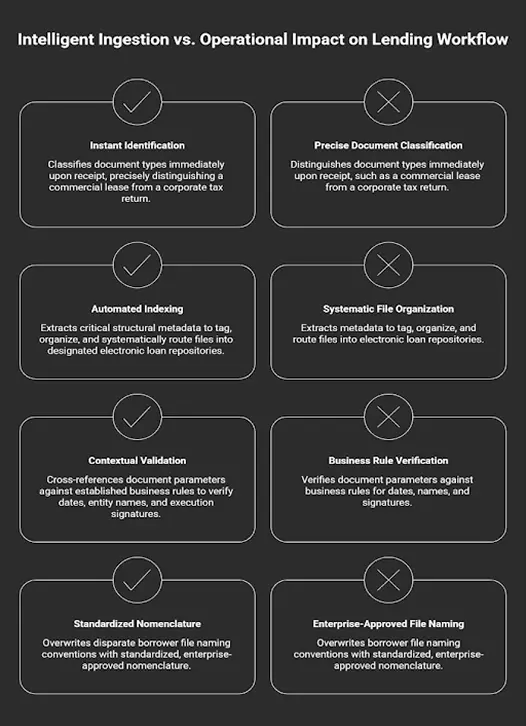
By automating document classification and indexing at inception, financial institutions eliminate the need for manual file sorting. Operational personnel are liberated from administrative sorting tasks, allowing resources to be redirected toward analyzing exceptions and accelerating loans into the underwriting phase with audit-ready precision.
To achieve this level of automation, lenders need more than a document upload portal. They need intelligent systems capable of validating, organizing, and preparing documents for downstream workflows.
DocVu.AI: The Intelligent Gatekeeper
Managing document intake at scale requires more than a secure upload portal. Lenders need a way to identify, validate, and organize incoming documents before they reach underwriting teams.
DocVu.AI helps address these challenges by automating key intake processes at the point of submission.
Key capabilities include:
- Automatic document classification and indexing.
- Real-time validation of incoming files.
- Data extraction from structured, semi-structured, and unstructured documents.
- Configurable business rules to flag missing or incomplete information.
- Integration with existing lending and document management systems.
By ensuring documents are properly categorized and reviewed at intake, operations teams spend less time sorting files and following up on missing information. This helps reduce delays, improve document quality, and move complete files into underwriting faster.
Schedule a demonstration with DocVu.AI to see how intelligent document intake can streamline operations, improve document quality, and accelerate lending workflows at scale.