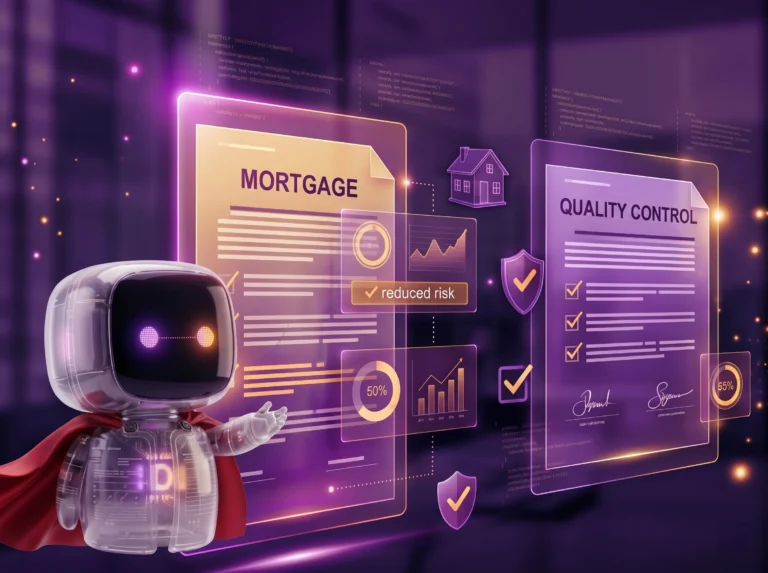
Mortgage servicing rights (MSR) transfers involve more than the exchange of servicing responsibilities. They require the organized transfer, review, and reconciliation of loan-level data and documentation so that the receiving servicer can continue servicing loans effectively.
As mortgage portfolios change ownership through acquisitions and servicing transfers, the volume of documentation that needs to be processed can place considerable pressure on operational teams. Loan files may contain documents in different formats, while incoming data must be reviewed against supporting records and the receiving servicer’s requirements.
Manual document handling can make this process time-consuming and increase the effort required to identify missing information or inconsistencies. AI-powered document processing offers an approach to streamlining document intake, indexing, data extraction, and validation, helping mortgage servicers manage documentation more efficiently during MSR portfolio onboarding.
How Does MSR Portfolio Onboarding Work?
MSR portfolio onboarding is the process of preparing loan information and supporting documentation for a receiving servicer as servicing rights are transferred. It involves organizing records, validating relevant data, and ensuring that the information needed to service the loans is available to the new servicer.
Depending on the portfolio and transfer arrangements, the process may involve:
- Document intake: Receiving loan files, servicing records, and supporting documentation from the transferring servicer.
- Document indexing: Classifying and organizing records so that relevant documents can be identified and retrieved.
Data extraction: Capturing key information from documents and converting it into structured data. - Data reconciliation: Comparing incoming loan-level data with corresponding documentation to identify discrepancies.
- Exception handling: Investigating missing records, inconsistent information, or other issues that require further review.
- System readiness: Preparing validated information for use within the receiving servicer’s established systems and workflows.
Each stage contributes to the quality and continuity of the transfer. An effective onboarding process helps teams identify issues early and manage the documentation required to support ongoing servicing.
Why Is Manual MSR Transfer Processing Challenging?
Manual processing can become difficult to manage when servicers need to handle large portfolios containing thousands of loan files. The challenges extend beyond the number of documents involved.
1. Document Volume and Format Variations
Mortgage servicing records can include scanned documents, PDFs, historical loan records, and structured data files. Differences in document formats and organization can make manual classification and indexing labor-intensive.
Teams must identify document types, associate records with the correct loans, and organize information for subsequent review. Repeating these tasks across a large portfolio can place considerable demands on operational resources.
2. Data Inconsistencies and Missing Information
Incoming loan data must be reviewed against relevant supporting documentation. Differences in loan details, incomplete records, or missing supporting documents may require additional investigation before the information can be accepted into the receiving servicer’s workflow.
If discrepancies are not identified and addressed during onboarding, they may require follow-up after the transfer, potentially increasing operational effort.
3. Time-Consuming Reconciliation
Reconciling loan-level information with supporting documents requires teams to locate relevant records, compare data, and investigate differences.
When these activities rely heavily on manual review, the time required can increase with portfolio complexity and document quality. Automation can help streamline routine processing while directing attention to discrepancies that need human review.
4. Maintaining Consistent Quality and Oversight
MSR transfers require appropriate controls, documentation, and coordination between the parties involved. Processing speed alone is not sufficient; loan information must also be handled accurately and reviewed according to applicable requirements.
A structured document processing workflow can help teams organize records, apply configured validation checks, and manage exceptions more consistently.
How AI-Powered Document Ingestion Can Streamline MSR Onboarding
AI-powered intelligent document processing can help mortgage servicers manage document-heavy onboarding activities through a combination of classification, extraction, indexing, and validation.
1. Intelligent Document Classification and Indexing
Loan files may contain multiple document types that need to be organized before their contents can be reviewed.
AI-powered document processing can help classify documents and assign relevant index information, making records easier to organize and retrieve. This reduces dependence on repetitive manual sorting and supports a more structured approach to managing incoming documentation.
2. Automated Data Extraction
Important loan information is often embedded in documents that can be difficult to process at scale through manual data entry alone.
Document processing technology can extract relevant information from scanned and digital records and convert it into structured data. Depending on the document type and configured workflow, this can help teams access key loan details while reducing the need for manual transcription.
3. Data Validation and Reconciliation
Extracted information needs to be checked against relevant records and the receiving servicer’s requirements.
Automated validation workflows can help identify missing fields, inconsistent values, and other discrepancies that warrant investigation. For example, a difference between an incoming loan record and its supporting documentation may be flagged for review.
This approach can help teams focus their attention on identified exceptions rather than relying exclusively on repetitive manual comparisons. The scope of validation depends on the available data, configured rules, and the specific requirements of the transfer.
4. Exception Management and Human Review
Not every document can be processed without intervention. Poor-quality scans, incomplete records, and conflicting information may require closer examination.
A well-designed workflow should allow exceptions to be routed for human review, enabling servicing teams to investigate issues and determine the appropriate next steps.
Human oversight remains important for resolving discrepancies, interpreting findings, and ensuring that decisions follow established procedures.
5. Preparing Data for Existing Servicing Workflows
Once documents have been processed and relevant information validated, the resulting data can support downstream servicing activities.
Depending on the solution configuration and available integrations, structured information can be prepared for use within existing systems and workflows. This can help reduce repetitive handling and support a more organized transition from document intake to subsequent review and processing.
Integration requirements should be assessed against the receiving servicer’s current technology environment and operational needs.
A Structured Workflow for AI-Assisted MSR Onboarding
AI-powered document processing can support MSR onboarding through a sequence of connected activities.
| Stage | Activity | Potential benefit |
|---|---|---|
| 1. Document intake | Collect and process incoming loan documentation | Creates a structured starting point for processing |
| 2. Classification and indexing | Identify document types and organize records | Improves document organization and retrieval |
| 3. Data extraction | Capture relevant information from documents | Reduces repetitive manual data entry |
| 4. Validation and reconciliation | Check extracted information against relevant records and configured rules | Helps identify discrepancies for review |
| 5. Exception handling | Route incomplete or inconsistent information for investigation | Focuses reviewer effort on issues requiring attention |
| 6. Downstream processing | Prepare validated information for established servicing workflows | Supports a more organized onboarding process |
The exact workflow will depend on portfolio characteristics, document availability, validation requirements, and the receiving servicer’s existing systems.
How AI Can Support Data Quality and Audit Readiness
Reliable documentation and accessible loan records are important throughout the MSR transfer process. Servicers need to be able to locate relevant information, investigate discrepancies, and demonstrate that their procedures have been followed.
Document processing automation can support these activities in several ways.
- Improved document accessibility: Indexing and classification help organize records, making relevant documents easier to locate during review.
- More consistent validation: Configured rules can support repeatable checks on extracted information and help identify data that requires further investigation.
- Better exception visibility: Flagging missing or inconsistent information can help teams prioritize unresolved issues.
- Support for review and documentation: Structured processing workflows can help organize information needed for internal reviews and other applicable oversight activities.
These capabilities can contribute to more efficient document management and quality checks. Audit readiness still depends on the servicer’s controls, recordkeeping practices, applicable requirements, and the evidence maintained throughout the process.
What Business Benefits Can AI-Powered MSR Onboarding Deliver?
When appropriately configured and integrated into existing workflows, AI-powered document processing can help mortgage servicing teams improve operational efficiency.
Key potential benefits include:
- Reduced manual processing: Automating document classification, indexing, and extraction can reduce repetitive administrative work.
- More efficient document review: Organized records and structured data can make information easier to access and assess.
- Earlier identification of discrepancies: Automated validation can help surface potential issues for investigation during onboarding.
- Better use of operational resources: Exception-based review can help teams focus on documents and data requiring additional attention.
- Support for changing portfolio volumes: Automated document processing can help teams manage document-intensive workflows as onboarding requirements change.
- Improved process visibility: Structured workflows can help teams track processing activities and manage outstanding review items, depending on the solution configuration.
Actual outcomes will vary according to portfolio size, document quality, workflow complexity, integration requirements, and the level of automation implemented.
How DocVu.AI Supports MSR Portfolio Onboarding
DocVu.AI helps organizations streamline document-intensive processes through intelligent document processing capabilities, including document classification, indexing, data extraction, and validation.
For mortgage operations, DocVu.AI supports quality checks, due diligence, and mortgage-related document processing. These capabilities are relevant to document-intensive activities associated with mortgage servicing rights and portfolio transfers.
By helping teams organize documents, extract relevant information, and validate data through configured workflows, DocVu.AI can support mortgage organizations in managing documentation more efficiently.
These capabilities can complement existing processes by reducing repetitive document-handling effort and helping teams identify information that requires further review. Implementation and integration requirements should be evaluated against each servicer’s specific on boarding workflow and technology environment.
Explore DocVu.AI’s Quality Checks & Audit solution to learn more about its document processing and quality control capabilities. You can also visit the DocVu.AI Mortgage industry page for more information about its mortgage-focused solutions.
Frequently Asked Questions
MSR portfolio onboarding is the process of preparing loan data, servicing records, and supporting documentation for a receiving servicer when mortgage servicing rights are transferred. It includes document organization, data validation, reconciliation, and preparation for ongoing servicing activities.
AI-powered document processing can help classify and index loan documents, extract relevant data, and support validation against available records. These capabilities can reduce repetitive manual work and help teams identify discrepancies for review.
MSR data reconciliation involves comparing loan-level information with relevant source documents and records to identify missing, inconsistent, or conflicting information. It supports the review of transferred data before and during onboarding.
AI-powered document processing can assist with document classification and indexing, helping organize loan records for easier retrieval and review. The extent of automation depends on document quality, document types, and the configured workflow.
No. Automation can reduce repetitive document-processing tasks and help identify potential exceptions, but human review remains important for resolving discrepancies, handling incomplete information, and making decisions that require judgment.
Not necessarily. Document processing solutions may be configured to work with existing systems, depending on available integration options and technical requirements. Servicers should evaluate compatibility, data flows, and implementation needs before deployment.
AI can help organize and index records, extract relevant information, and support consistent validation workflows. These capabilities can make information easier to retrieve and review, while audit readiness continues to depend on the servicer’s controls and recordkeeping practices.
Conclusion
MSR portfolio transfers require careful coordination of loan documentation, data, and servicing information. As portfolios grow and document formats vary, manual processing can create additional demands on operational teams.
AI-powered document ingestion offers a way to streamline document classification, indexing, extraction, and validation. By helping organize loan records and identify potential discrepancies, automation can support more efficient onboarding while allowing servicing professionals to focus on exceptions and decisions that require human oversight.
With intelligent document processing capabilities from DocVu.AI, mortgage organizations can explore a more structured approach to document-intensive workflows and strengthen the processes that support mortgage servicing operations.