

Why Are Lenders Turning to Agentic Document Extraction?
Mortgage teams today deal with huge files, tighter checks, and constant pressure to move loans faster. According to the Mortgage Bankers Association (MBA), production expenses reached about $12,579 per loan in Q1 2025. The old idea of “extract a few fields and move on” doesn’t match the real workload anymore. That’s why more lenders are exploring agentic AI, systems that don’t just read documents but understand intent, spot what’s missing, and help move the file to the next step without waiting for someone to guide it. The result is a smoother, cleaner workflow that helps teams stay ahead instead of catching up.
How Does Agentic AI Change the Way Documents Are Understood?
Older tools only read what is on the page. Agentic AI actually understands why a document is in the file and what it should do next. Instead of stopping at automated data extraction, it looks at the document in context. It can tell whether something is a pay stub or a bank statement, what details the underwriter will expect, and what is missing before the file moves ahead.
This level of document intelligence cuts down on repeat checks and back-and-forth emails. It also supports stronger mortgage automation, because the system is not just pulling data, it is getting the file ready for a decision. That shift is why many lenders are moving past the old extract-and-park approach.
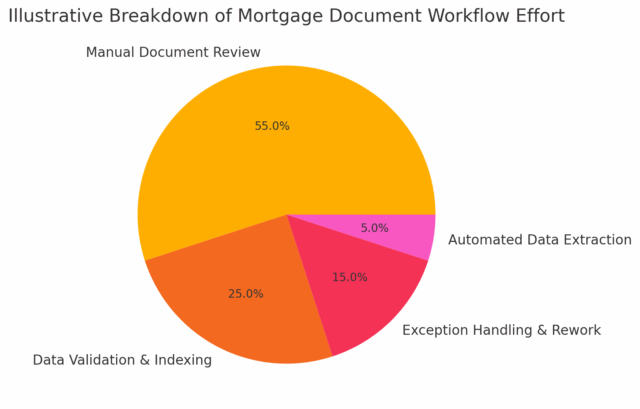
What Does This Breakdown Tell Us About Today’s Document Workflows?
The chart shows how uneven today’s document workload really is. More than half of the effort goes into manual review alone, which reflects how much time teams still spend reading, checking, and organizing documents. Another 25 percent is spent on validation and indexing, and 15 percent on fixing exceptions and rework. Only 5 percent comes from true automation, mostly basic extraction. This imbalance highlights why lenders are moving toward agentic AI and stronger document intelligence to reduce manual heavy lifting and shift more work into automated, decision-ready steps.
What Makes Agentic AI Better at Handling Document Variety?
One of the biggest challenges in mortgage operations is the sheer variety of documents that show up in a file. Formats change, layouts shift, and every lender has a mix of PDFs, scans, images, and multi-page forms. This is where agentic AI stands out. Instead of relying on strict templates, it uses document intelligence to understand each file based on structure, context, and intent. It can adjust to new document styles, pick up patterns across pages, and recognize the same data even when it appears in different layouts.
This adaptability makes automated data extraction far more reliable and gives teams the confidence to scale mortgage automation without worrying about document inconsistencies slowing them down.
How Decision Ready Files Change the Speed of Review
The biggest shift with modern document workflows is how much cleaner a file looks by the time it reaches review. Instead of starting with sorting, cross checking, and fixing gaps, teams receive information that has already been organized, validated, and matched across documents. The system identifies what is missing early, aligns data formats, and groups related details in a way that supports quick judgment. This reduces pauses, cuts down back and forth questions, and helps underwriters move through files with more confidence. It also creates a smoother handoff across the rest of the loan process.
Way forward
The transition toward intelligent document operations is already underway, and lenders are realizing that the real gains come from reducing friction long before a file reaches review. As agentic capabilities mature, teams can expect fewer manual loops, clearer files, and faster movement across the loan process. The goal is not to replace people but to give them cleaner inputs and more time for the work that requires judgment. This is the direction mortgage operations are heading in, and the lenders who adapt early will feel the benefits first.