

Mortgage lenders currently face an operational paradox. While global lending volume is projected to grow steadily through 2030, the internal cost of processing remains unsustainably high. Industry data indicates that manual document management and repetitive data entry consume up to 30 percent of total loan processing resources.
In a market where borrowers expect immediate transparency and investors demand tighter compliance, these inefficiencies represent a direct source of operational risk and margin erosion. They are a primary source of operational risk and financial leakage.
The Core Challenges in Document Lifecycle Management
Many lenders attempt to solve these issues with isolated point solutions. However, these tools often fail because they do not address the root causes of friction. Below are the seven logical pressure points that consistently delay the path to funding.
These challenges typically emerge not from a lack of effort, but from fragmented systems and delayed validation across the document lifecycle.
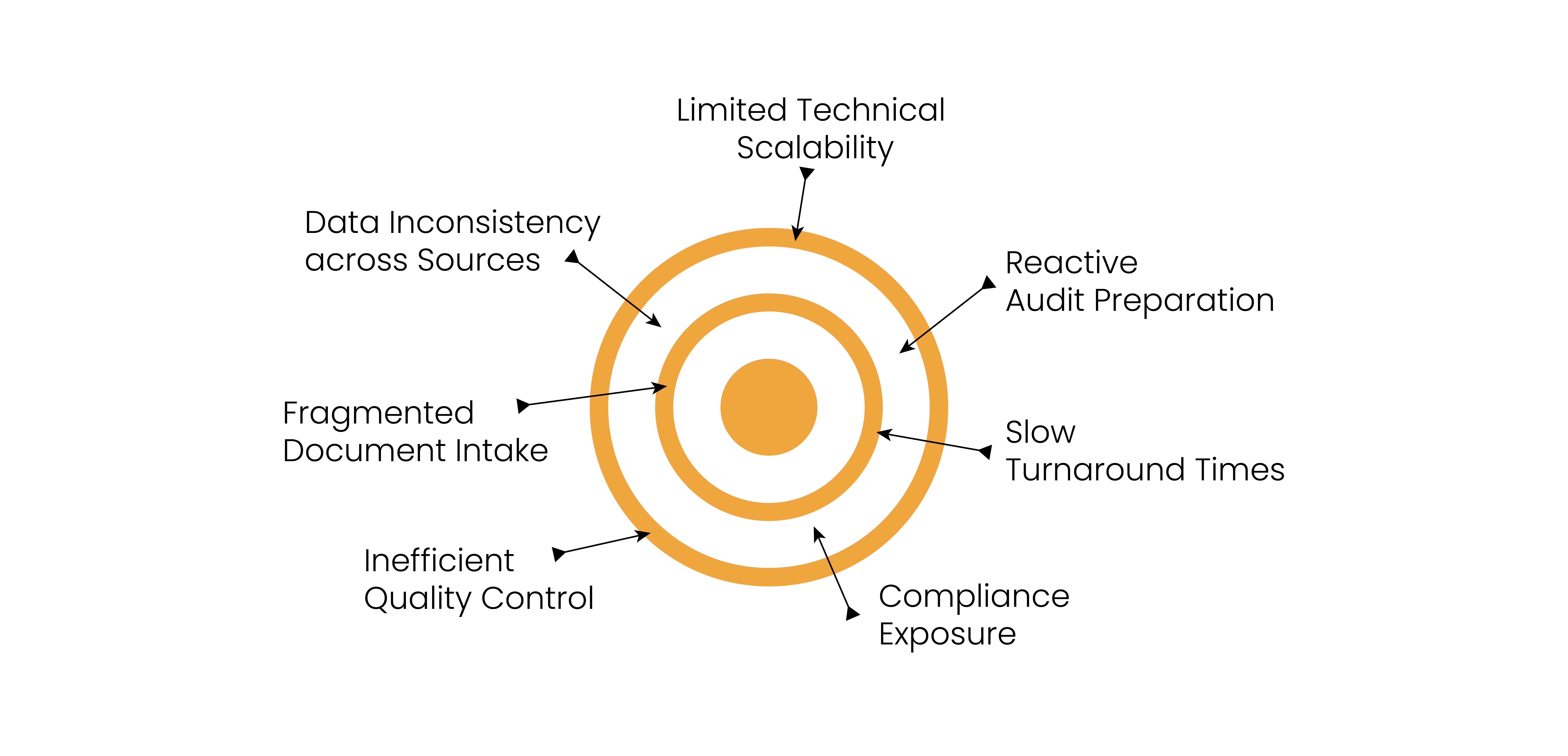
- Data Inconsistency across Sources: Discrepancies between the initial applications, third party uploads, and final disclosures create a need for constant manual reconciliation.
- Fragmented Document Intake: High volumes of files arrive through disparate channels, leading to missing documents that are often only discovered late in the underwriting process.
- Inefficient Quality Control: Quality checks performed late in the lifecycle are inherently reactive. This forces staff to “re-work” files, which doubles the operational cost per loan.
- Limited Technical Scalability: Traditional methods rely on adding headcount to manage volume spikes. This approach is not sustainable in a fluctuating interest rate environment.
- Reactive Audit Preparation: When document indexing is disorganized, preparing for investor or regulatory audits becomes a time intensive recovery project rather than a standard output.
- Slow Turnaround Times: Manual data extraction slows down the initial validation phase, directly degrading the borrower experience and increasing the likelihood of rate lock extensions.
- Compliance Exposure: Without automated version control and validation, the risk of delivering a non-compliant file to the secondary market remains high.
Building a Disciplined Workflow with DocVu.AI
Modernizing these operations requires a shift from manual review to automated document intelligence. By implementing controlled workflows and early validation, lenders can build confidence in every file from the moment of ingestion.
DocVu.AI facilitates this transition by providing a structured, audit-ready environment. The platform ensures that data is captured accurately and validated early, allowing your team to focus on exception handling rather than data entry. This approach helps lenders reduce operational friction and maintain high quality standards across the entire mortgage lifecycle.
The result is faster cycle times, cleaner files, and predictable downstream outcomes for underwriting, post-close, and audits.
How DocVu.AI Transforms Document Operations
The challenges outlined above are not just administrative hurdles; they are systemic barriers to growth. As we move further into 2026, the lenders who succeed will be those who replace reactive manual checks with proactive Intelligent Document Processing (IDP). This technology serves as the foundation for modernizing the back office, turning unstructured data from hundreds of pages into actionable insights.
- Accelerating Data Accuracy and Speed
Manual data entry remains a primary cause of slow turnaround times. DocVu.AI utilizes advanced machine learning to identify and extract key data points from pay stubs, tax returns, and bank statements with accuracy rates exceeding 99 percentage in controlled production environments. By automating this high-volume task, lenders can reduce the time spent on manual review by up to 80 percent. This ensures that the data moving through your workflow is verified at the point of ingestion, preventing errors from snowballing into closing-day delays. - Strengthening LOS Integration and Workflow Continuity
A common failure of legacy software is the inability to communicate with the broader tech stack. DocVu.AI is built specifically for seamless Loan Origination System (LOS) Integration. This connectivity ensures that once a document is classified and data is extracted, it flows instantly into the underwriting environment. By eliminating data silos, lenders can maintain version control and ensure that underwriters are always working with the most current borrower information, significantly reducing the need for repetitive document requests. - Real-Time Operational Risk Mitigation
In a tightening regulatory environment, compliance cannot be treated as a post-closing activity. DocVu.AI builds audit readiness into the lifecycle from day one. The platform automatically flags missing signatures, expired documents, and data mismatches the moment they are uploaded. This shift toward “Quality at Intake” serves as a powerful form of Operational Risk Mitigation, as it prevents non-compliant files from ever reaching the funding stage and minimizes the risk of costly investor buybacks - Scalability through Mortgage Process Automation
The mortgage market is inherently cyclical, and traditional staffing models often struggle to keep pace with volume spikes. Mortgage Process Automation allows lenders to scale their operations elastically without a corresponding increase in headcount. Because DocVu.AI handles the repetitive tasks of document indexing and cross-referencing, your existing team can manage a significantly larger pipeline. This operational agility is critical for maintaining margins in a fluctuating interest rate environment.
The Path Forward: Modernizing for 2026 and Beyond
Lenders can no longer afford to treat document management as a secondary concern. The transition to a structured, automated workflow is now a baseline requirement for maintaining competitive turnaround times and meeting borrower expectations.
As lenders plan for 2026 and beyond, success will depend not on whether automation exists, but on how early intelligence is applied to control risk, speed, and quality.