
Every mortgage loan file tells a story, but that story is buried under hundreds of pages of documents. Bank statements, tax returns, pay stubs, disclosures, appraisal reports each page contains data that directly impacts approval speed, compliance, and borrower experience.
In 2026, mortgage lenders can no longer afford to manually search, read, and retype this information. Rising cost-per-loan, tighter regulations, and digital-first borrower expectations have made mortgage data extraction a strategic priority.
This guide explains what mortgage data extraction is, why it matters in 2026, how automation works, and how platforms like DocVu.AI help lenders turn document chaos into structured, decision-ready data.
What Is Mortgage Data Extraction?
Mortgage data extraction is the process of identifying, capturing, and structuring key information from documents inside a mortgage loan file.
Instead of processors manually typing values into systems, intelligent automation extracts data such as:
- Borrower and co-borrower details
- Income and employment information
- Assets, liabilities, and balances
- Loan terms, fees, and closing amounts
- Property and appraisal data
The output is clean, structured data that underwriting, QC, and loan origination systems can instantly use.
Why Mortgage Data Extraction Matters in 2026
Mortgage origination costs continue to rise, driven largely by manual document handling. Industry studies show that manual data entry and document checks account for nearly two-thirds of total loan production costs.With cost-per-loan projected to hit $8,000+ in 2026 (MBA Forecast), automation is non-negotiable.
At the same time:
- Loan files are growing larger and more complex
- Borrowers expect faster approvals
- Regulators demand cleaner audit trails
In 2026, mortgage data extraction is no longer about efficiency alone, it’s about survivability and scalability.
Common Mortgage Data Extraction Workflows
Lenders extract data from loan files every day, including:
- Borrower name, address, SSN, and employer from the 1003 (URLA)
- Gross and net income from pay stubs
- Deposits, withdrawals, and balances from bank statements
- Qualifying income from tax returns and transcripts
- Rates, fees, and cash-to-close from LEs and CDs
- Property values and comps from appraisal reports
- Liabilities and credit scores from credit reports
If a value exists in a document, someone is likely re-entering it manually creating delays and errors.
Types of Mortgage Documents Commonly Extracted
Modern mortgage data extraction systems handle:
- 1003 / URLA
- Loan Estimates (LE)
- Closing Disclosures (CD)
- Pay stubs
- W-2s and 1099s
- Bank statements
- Tax returns (1040,
- Schedule C/E)
- VOE, VOI, VOD forms
- Credit reports
- Appraisals and purchase
- contracts
A single loan file can exceed 1,000 pages, making automation essential.
Challenges with Manual Mortgage Data Extraction
Key Pain Points of Manual Processing
Manual extraction creates friction across mortgage operations:
- High error rates – Industry averages show 10–15% defects in early-stage manual processes
- Repetitive work – The same values are checked across multiple documents
- Rising labor costs – Manual effort drives cost-per-loan upward
- Slow turnaround times – Borrower and investor expectations are missed
Staff burnout – Teams spend hours searching and typing instead of evaluating risk
Why OCR and Rule-Based Systems Fall Short
Traditional OCR systems were never designed for mortgage complexity.
They struggle with:
- Variable document layouts
- Tables and multi-column formats
- Handwritten or scanned content
- Frequent template changes
Rule-based systems break the moment documents change. Mortgage files change constantly making flexibility essential. DocVu.AI’s template-less IDP overcomes these with adaptive AI.
How Automated Mortgage Data Extraction Works
Modern mortgage data extraction uses Intelligent Document Processing (IDP) combined with AI.
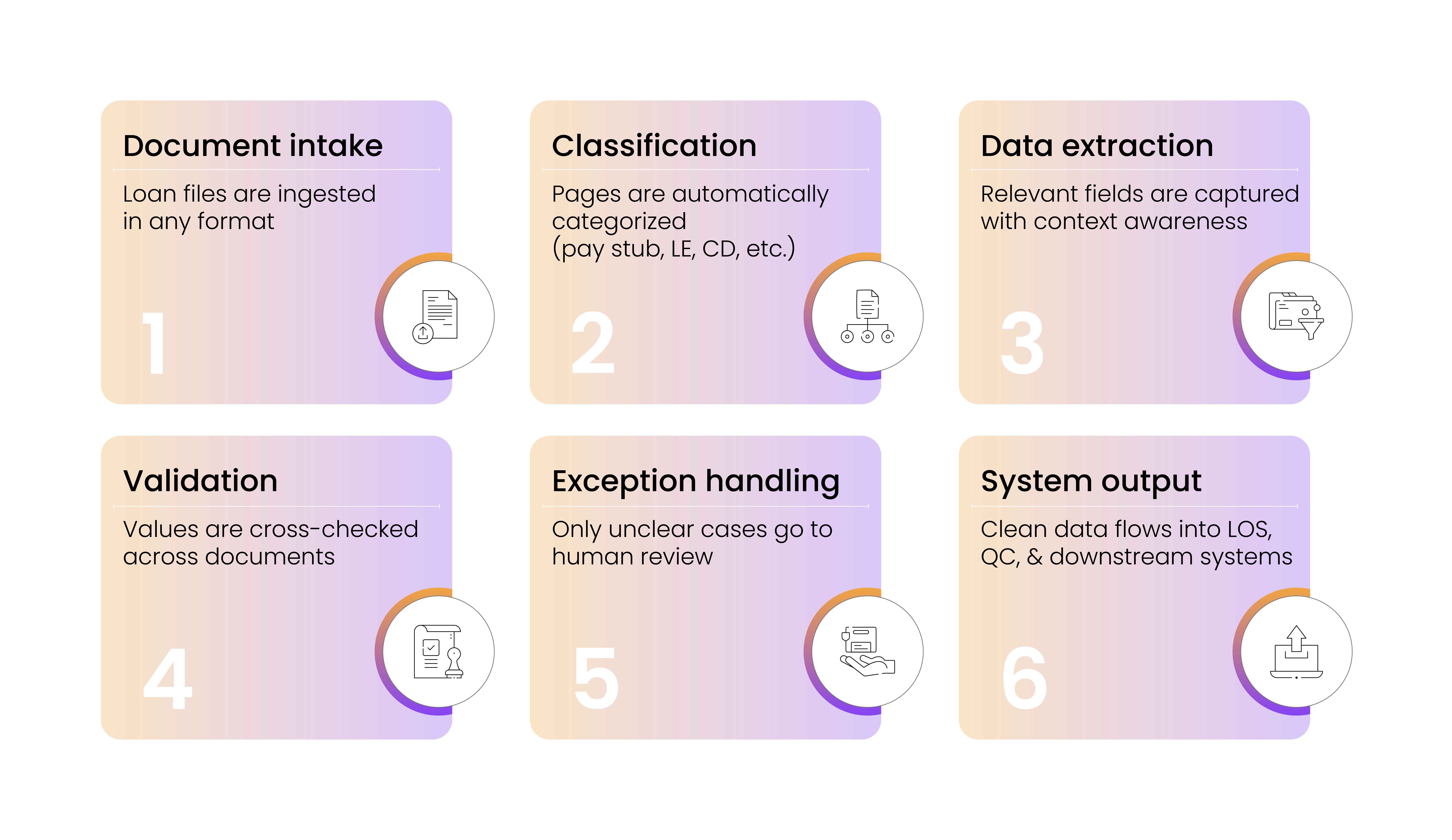
This approach delivers speed without sacrificing accuracy or compliance.
Advantages of Automated Mortgage Data Extraction
Faster Loan Processing
Automation reduces document handling time from hours or days to minutes shortening overall cycle times.
Higher Accuracy and Fewer Defects
AI-driven validation significantly reduces manual errors and rework.
Lower Cost per Loan
By eliminating repetitive data entry, lenders reduce operational expenses and improve margins.
Better Experience for Mortgage Teams
Underwriters and processors focus on judgment and exceptions—not document hunting.
Stronger Compliance and Audit Readiness
Automation creates consistent, traceable workflows that support regulatory audits.
Core Technologies Powering Mortgage Data Extraction
Intelligent Document Processing (IDP)
IDP reads and understands documents rather than just capturing text.
Machine Learning (ML)
Models improve accuracy over time using historical mortgage data.
Natural Language Processing (NLP)
NLP understands context within unstructured documents.
Computer Vision
Computer Vision interprets tables, stamps, signatures, and scanned content.
Together, these technologies allow systems to read documents like experienced mortgage professionals—only faster.
Why Mortgage Leaders Choose DocVu.AI
DocVu.AI is purpose-built for document-intensive industries like mortgage lending.
DocVu.AI enables lenders to:
- Automatically classify and index mortgage documents
- Extract and validate critical data with high accuracy
- Detect missing or inconsistent documents early
- Maintain audit-ready workflows at scale with full traceability for TRID and Reg Z compliance
With template-less processing and enterprise-grade security(SOC 2,HIPAA-ready), and seamless integrations (LOS like Encompass, Blend), DocVu.AI helps lenders modernize mortgage operations without disrupting existing systems.
Getting Started with Mortgage Data Extraction
Successful lenders start small and scale fast:
- Begin with a high-volume document type (pay stubs or bank statements)
- Run a controlled pilot
- Measure time saved and error reduction
- Expand to additional documents
- Integrate deeper with LOS and QC systems
This approach minimizes risk while delivering quick wins.
Final Thoughts
Mortgage data extraction has become foundational infrastructure for modern lending. As loan files grow larger and expectations rise, manual processing simply cannot keep up.
In 2026, lenders that automate mortgage data extraction will operate faster, more accurately, and more confidently—while those that delay will face rising costs and shrinking margins.