
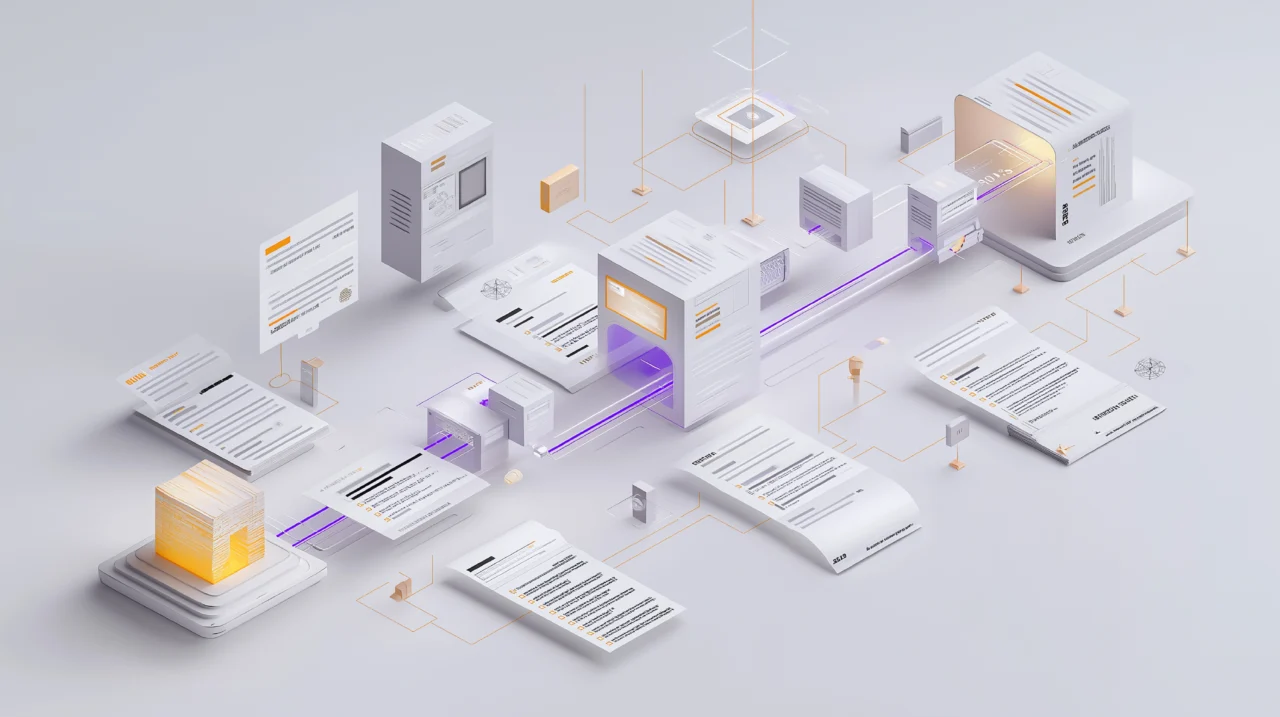
The mortgage industry is entering a defining phase. By 2026, lenders will no longer compete only on interest rates rather they will compete on speed, accuracy, compliance confidence, and digital experience.
Yet mortgage operations remain one of the most document-intensive workflows in financial services. Loan files include hundreds of documents, such as bank statements, tax forms, disclosures, and income proofs, which are submitted in inconsistent formats and across multiple channels. Manual handling of this complexity is no longer sustainable.
This is why mortgage process automation, powered by Intelligent Document Processing (IDP), is becoming essential infrastructure for lenders preparing for 2026 and beyond.
What Is Mortgage Process Automation?
Mortgage process automation uses AI-driven technologies to digitize, classify, extract, and validate information from mortgage documents across the loan lifecycle.
Unlike traditional automation, which focuses on task execution, modern mortgage automation understands documents. It enables lenders to automatically:
- Index loan files
- Identify missing or incorrect documents
- Extract borrower and loan data
- Validate information against rules and policies
- Route files for underwriting and decisioning
The result is faster processing, fewer errors, and scalable operations.
Why Mortgage Automation Becomes Mandatory in 2026
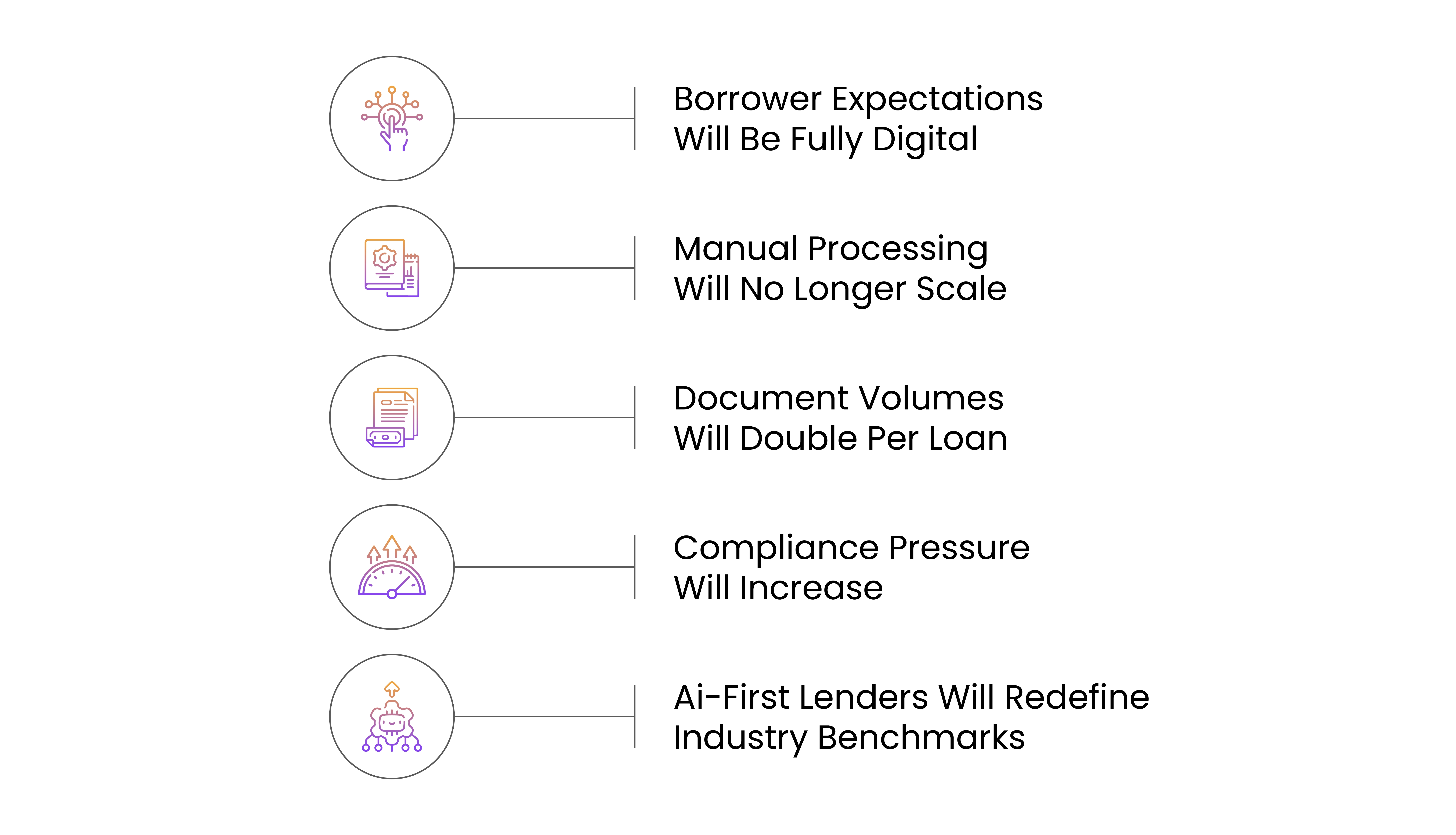
- Borrower Expectations Will Be Fully Digital
Research from Fannie Mae consistently shows that over 80% of borrowers prefer digital-first mortgage experiences. By 2026, slow document reviews and repeated submission requests will directly impact conversion and abandonment rates.Automation enables near real-time document intake and verification—meeting borrower expectations without increasing operational load. - Manual Processing Will No Longer Scale
Mortgage demand is cyclical. Manual workflows break under volume spikes, causing delays, backlogs, and staff burnout.According to McKinsey & Company, AI-powered automation can improve operational productivity by 2–3× while reducing turnaround time by up to 60%. In 2026, lenders that rely on manual processing will face structurally higher costs than AI-enabled competitors. - Document Volumes Will Double Per Loan
By 2026, the average mortgage file is expected to contain 2× more documents due to:- Expanded borrower verification
- Regulatory requirements
- Multi-channel submissions (mobile, email, portals)
Template-based OCR systems struggle with this variability. IDP platforms process both structured and unstructured documents without rigid templates—making them essential for handling document sprawl at scale.
- Compliance Pressure Will Increase
Regulatory scrutiny around KYC, AML, auditability, and data privacy continues to intensify.Studies from Deloitte highlight that manual mortgage workflows experience error rates between 10–15%, while AI-driven document automation reduces errors to below 2–3%.
Automation provides:- Consistent rule-based validation
- End-to-end audit trails
- Reduced compliance and rework costs
By 2026, automation will be the safest way to maintain regulatory confidence.
- AI-First Lenders Will Redefine Industry Benchmarks
According to Gartner, more than 70% of document-heavy workflows in financial services will be AI-automated by 2026.
These AI-first lenders will set new standards for:- Loan approval speed
- Accuracy and data quality
- Customer experience
Late adopters will struggle to compete against organizations where document intelligence is built into every workflow.
Key Technologies Powering Mortgage Automation
Modern mortgage automation platforms combine:
- Intelligent Document Processing (IDP): Automated document classification, extraction, and validation
- Optical Character Recognition (OCR): Converts scanned documents into machine-readable data
- Natural Language Processing (NLP): Understands context within unstructured mortgage documents
- Machine Learning (ML): Improves accuracy over time using historical data
- Agentic Process Automation(APA): AI agents that autonomously orchestrate workflows, make context-aware decisions, trigger actions, and escalate exceptions across systems
Together, these technologies enable end-to-end automation across mortgage operations.
Why Mortgage Leaders Choose DocVu.AI
DocVu.AI is purpose-built for document-intensive industries like mortgage lending.
DocVu enables lenders to:
- Automatically classify and index mortgage documents
- Extract and validate critical loan data with high accuracy
- Detect missing or inconsistent files early
- Maintain audit-ready workflows at scale
By combining intelligent automation with enterprise-grade reliability, DocVu helps mortgage teams process loans faster, reduce operational risk, and prepare confidently for 2026.
Final Thoughts: Automation Is the Mortgage Industry’s New Baseline
In 2026, mortgage process automation will no longer be a competitive differentiator—it will be the baseline for operating effectively.
Lenders that invest now in intelligent document processing will gain:
- Faster approvals
- Lower costs
- Stronger compliance
- Better borrower experiences
Those that delay will find it increasingly difficult to compete in an AI-first mortgage ecosystem.
Want to prepare your mortgage operations for 2026?
Explore how DocVu.AI can transform your mortgage document workflows—from intake to close—with intelligent, scalable automation.